
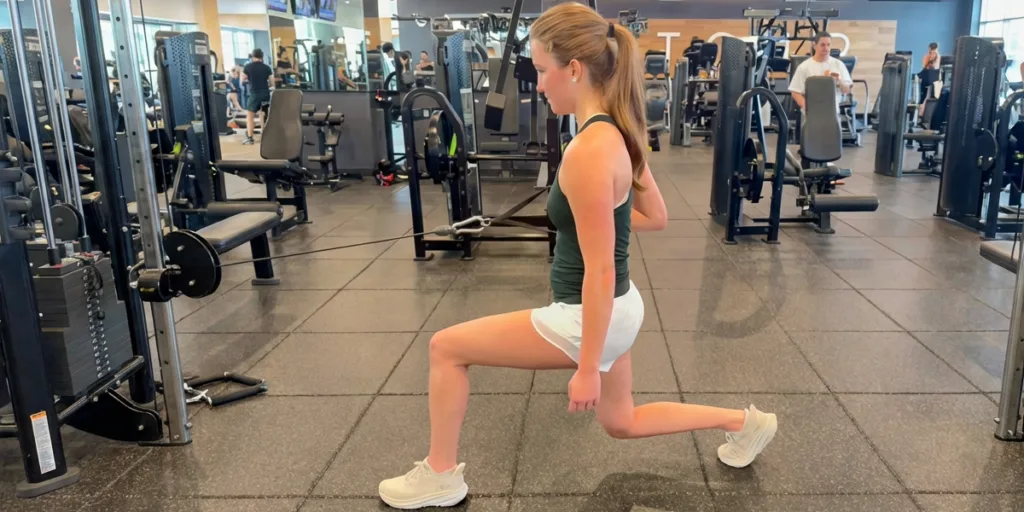
Static lunge with row is a knee-friendly exercise that strengthens your core and legs while reducing stress on the front of the knee. You hold a stationary lunge position while performing a rowing motion, which adds a lot of core engagement and helps support essentially every other exercise you do. This combination is especially helpful for people who find walking lunges too irritating but still need single-leg strength and balance work.
For many patients with knee pain, it is easier to tolerate a static lunge instead of moving through space. Walking lunges can really load the front of the knee, but the static lunge is often much better tolerated while still building strength and stability. That makes static lunge with row a practical option for home programs, gym routines, and return‑to‑activity plans.
What Is a Static Lunge With Row?
Static lunge with row combines a stationary lunge position with a rowing motion using a dumbbell, cable, or resistance band. You step into a lunge, hold your feet in place, and perform a row with the arm holding the weight or band, which works the upper back and core while your legs support your body weight. Because your feet do not travel forward or backward with each rep, the exercise is more stable and often more comfortable than walking lunges for people with knee pain.
Why It’s Knee‑Friendly
Static lunges tend to feel more controlled than walking lunges because you avoid the repeated stepping and deceleration that can increase load on the front of the knee. For many patients with anterior knee pain, keeping the lunge in place is better tolerated while still targeting the quadriceps, glutes, and hamstrings for strength and stability. The row adds core and trunk involvement, helping you feel more stable with everyday tasks.
How to Perform a Static Lunge With Row
-
Stand with your feet hip‑width apart, holding a dumbbell, cable handle, or band handle in one hand
-
Step one foot into a lunge stance, keeping your front knee roughly over the middle of your foot and your torso upright.
-
Lower into a comfortable lunge depth and hold that position; you do not have to move through the lunge if your knee is sensitive.
-
From this position, pull your elbow back into a row, keeping your shoulder down and your core braced.
-
Slowly return your arm to the starting position, maintain the lunge, and repeat for the desired reps before switching sides.
Progressions and When to Modify
If you have more knee pain or balance issues, start with a shallower lunge and consider light support from a counter or rail. You can begin by practicing the static lunge position first, then add the row once you feel stable. As strength improves, gradually increase lunge depth, resistance, or time under tension while monitoring how the front of the knee feels.
If pain becomes sharp, catches, or swelling increases, it may be a sign to adjust or temporarily avoid this exercise and focus on lower-load options like partial squats or supported sit‑to‑stands. The goal is steady progress without flaring symptoms. Check out my other patient exercise videos for more ideas as well.
FAQ
Is static lunge with row better than walking lunges if I have knee pain?
For many people with knee pain, a static lunge is easier to tolerate than walking lunges, which can really load the front of the knee as you move through space.
Why add a row to the static lunge?
Adding a row gives you a lot of core engagement on top of the lunge, which is helpful and supports essentially every other exercise you do.
Do I have to move up and down in the lunge?
You do not have to move through the lunge; holding a static position is often more comfortable for patients who have knee pain yet still want to strengthen their legs and core.
This exercise is intended for people who want to build strength and stability while being mindful of knee symptoms. If your knee pain worsens, becomes sharp, or lingers after you finish, it is always best to discuss this with your treating clinician before progressing.
Watch the short video for a demonstration and practical form cues.